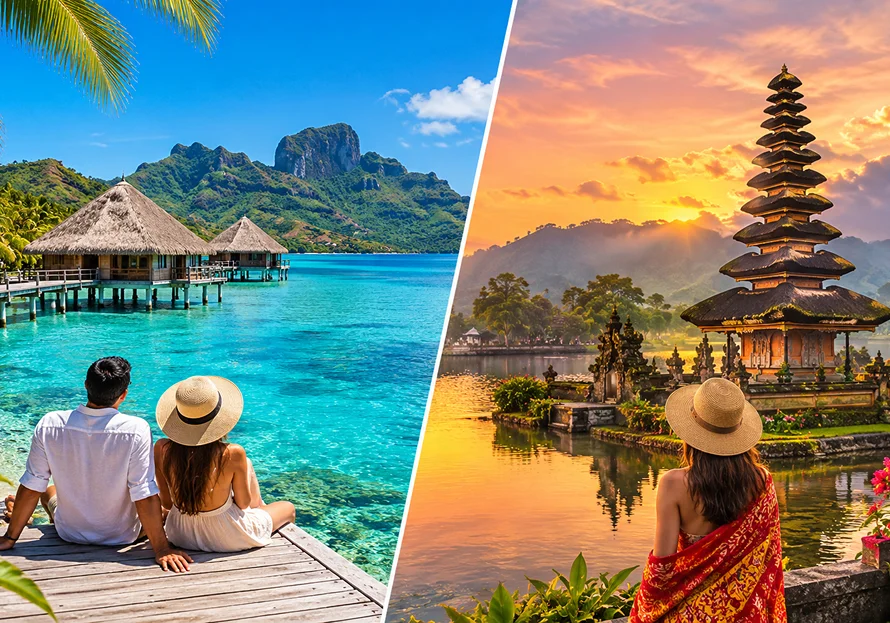
Close your eyes for a second and picture your ideal week off. Is it a hammock strung between two palms, nothing but ocean and silence for company? Or is it waking up to temple bells, wandering through rice terraces, and ending the day with a local meal after exploring somewhere new?
That mental image goes a long way towards deciding between Fiji and Bali, because both destinations offer a genuine escape, just through very different experiences.
For Australians, both are popular short-haul international holiday options. The better fit depends less on which destination is universally better and more on what you want from your time away. Let’s look at the practical differences, from flight times and beaches to culture, food and overall holiday costs.
Fiji vs Bali: The Quick Snapshot
Before diving into the details, here’s the short version for anyone who wants the gist before committing to a full read:
Factor | Fiji | Bali |
Vibe | Quiet, resort-based, laid-back | Vibrant, varied, culturally rich |
Beaches | Pristine, less crowded | Mixed – some busy, some untouched |
Best for | Couples, families wanting ease, honeymooners | Solo travellers, culture-seekers, budget explorers |
~4 hrs direct from Sydney/Melbourne | ~4 hrs from Perth, ~6 hrs from east coast | |
Food scene | Mostly resort dining, Westernised menus | Endless local warungs and street food |
Flight durations are approximate scheduled times and can vary by airline, route and travel date. Flight availability also differs by Australian departure city, so a short theoretical flight time does not necessarily mean a convenient direct service operates every day.
Flight Time and Access: Which Destination Is Easier to Reach?
One of the first things Australians consider when planning a holiday to Fiji or Bali is simply: how easy is it to get there?
Fiji is approximately 4.5 hours from Sydney and around 5 hours from Melbourne on direct services, making it a relatively short international journey from Australia’s east coast.
Bali is roughly 3.5–4 hours from Perth and around 6 hours from Sydney or Melbourne, depending on the route and schedule.
These are approximate scheduled flight durations rather than guarantees. Your actual journey can vary according to the airline, routing, aircraft, weather and operating schedule. It’s also worth checking whether a non-stop service is available from your departure city on your specific travel date.
For Australians choosing between the two, the most convenient option can therefore depend heavily on where in Australia the journey starts.
The Vibe Check: Fiji vs Bali Holiday Atmosphere
This is where the two destinations really start to pull apart.
Fiji is spread across numerous islands, with many visitors choosing resorts where the pace is deliberately slower. A typical holiday might involve spending the morning by the water, taking a snorkelling trip in the afternoon and doing very little in the evening.
Bali operates at a different pace. Between Kuta’s energy, Canggu’s café culture, Ubud’s yoga and rice-terrace experiences, and the quieter areas around the island, there is a broad range of things to see and do.
That makes the choice largely about the type of holiday you want. Fiji can work particularly well when relaxation and resort convenience are priorities, while Bali provides plenty of opportunities to combine downtime with sightseeing, food, culture, shopping and day trips.
Bali vs Fiji Vacation: Which Wins on Beaches?
If beaches are the deciding factor, both destinations offer different experiences.
Fiji is known for its island landscapes, clear waters and beaches that can feel particularly peaceful away from the more developed resort areas. Travellers staying on smaller islands may find that the surrounding environment becomes a major part of the holiday.
Bali’s beaches are more varied. Popular areas can be busy, particularly around well-known tourist centres, while other parts of the island offer quieter coastal experiences. Surfing, beach clubs and sunset spots are also an important part of Bali‘s appeal.
Rather than assuming one destination has universally better beaches, consider what you want from them. If your ideal beach day means a quiet stretch of sand and time at a resort, Fiji may fit that style. If you want beaches combined with restaurants, nightlife, surfing and other activities, Bali provides more variety in a relatively compact destination.
Culture and Food: Two Different Experiences
Culture is one area where it’s better to compare the experiences available rather than rank the destinations.
In Bali, Hindu traditions are highly visible in everyday life. Temple ceremonies, offerings and religious practices form an important part of the island’s cultural landscape. Visitors should be mindful of local customs, particularly when visiting temples and participating in cultural or religious experiences.
Food is another major part of the experience, with local warungs, traditional dishes and a wide range of Indonesian and international cuisine available across the island.
Fiji has its own distinct cultural identity. Indigenous iTaukei culture is an important part of Fijian life, alongside significant Indo-Fijian and other cultural influences. Visitors can encounter local traditions through village visits, cultural activities, food, music and community experiences, depending on where they stay and what they choose to do.
Fijian cuisine also goes beyond resort menus, although the dining experience can vary considerably between resorts, towns and local communities.
The key difference is not that one destination has “more” culture. They offer different cultural environments and ways for visitors to engage with them.
Budget Comparison: What Can Affect the Cost?
The overall cost of a holiday depends heavily on where you stay, when you travel and how you spend your days. Instead of comparing a single room price or daily budget, it’s more useful to look at the factors that can influence the total trip cost.
Cost factor | Fiji | Bali |
Accommodation | Resorts, hotels, hostels and guesthouses; options vary significantly by island and location | Wide range from hostels and guesthouses to hotels and luxury resorts |
Luxury stays | Strong resort and island options, including adults-only properties | Extensive range of luxury hotels, villas and resorts |
Meals | Resort dining, local restaurants and Indo-Fijian/Fijian food options | Local warungs, restaurants, cafés and hotel dining |
Transport | Island transfers and resort transfers can affect the overall budget | Taxis, private drivers and other local transport options |
Activities | Snorkelling, island trips, water activities and resort excursions | Cultural sites, day trips, activities, attractions and beach experiences |
Other costs | Resort packages, transfers and excursions can influence the final spend | Tourist levy, transport, activities and accommodation location can affect the final spend |
Bali can offer considerable flexibility for travellers who want to control everyday spending, particularly through local dining and different accommodation options.
Fiji can also work across different budgets, but the final cost can be influenced by resort location, meal plans, transfers between islands and organised activities.
For either destination, it’s worth comparing the complete holiday cost, rather than looking only at the nightly accommodation rate or airfare.
Which One Actually Suits Your Travel Style?
Rather than asking which destination is better overall, consider what you’re looking for from the trip:
- Couples wanting a slower, resort-focused escape → Fiji offers plenty of island and resort options suited to relaxation.
- Families looking for resort convenience → Fiji has a range of family-oriented resorts, activities and accommodation options.
- Solo travellers wanting variety and social experiences → Bali offers extensive accommodation, dining and activity choices.
- Travellers interested in culture and local experiences → Both offer opportunities to engage with local culture, although the experiences are very different.
- Budget-conscious travellers → Bali provides a broad range of accommodation, dining and transport options that can make it easier to adjust daily spending.
- Travellers wanting a straightforward short international escape → Compare your departure city, available direct services and travel dates before deciding.
Ultimately, think about what you actually want to do on a good day off. If it’s mostly “slow down and switch off”, Fiji may fit naturally. If it’s “wander, eat, explore and discover”, Bali offers plenty of ways to build that kind of holiday.
Booking Your Fiji or Bali Holiday the Smart Way
Whichever destination you choose, the flight itself is worth comparing properly rather than booking the first fare that appears.
Flight availability and prices can change depending on your Australian departure city, travel dates, airline and booking conditions. A direct service may also be available on some dates but not others.
BookMyTrip helps Australian travellers compare flight options, making it easier to look at available fares and routes before booking your holiday.
Whether Fiji or Bali is on your shortlist, comparing the full itinerary rather than just the headline fare can help you understand what you’re actually getting for your travel budget.
Frequently Asked Questions
Which is cheaper for a holiday, Fiji or Bali?
The overall cost depends on accommodation, travel dates, dining, transport and activities. Bali offers a wide range of accommodation and local dining options, while Fiji’s costs can be influenced by resort packages, island transfers and meal plans.
Is Fiji or Bali better for families?
Both destinations offer family-friendly accommodation and activities. Fiji has many resorts designed around family stays, while Bali provides a broader mix of hotels, villas, attractions, restaurants and activities that can suit different family travel styles.
Which has better beaches, Fiji or Bali?
Both offer different beach experiences. Fiji is known for its island beaches and clear waters, while Bali has a wider mix of popular, surf-oriented and quieter coastal areas. The right choice depends on whether you prioritise seclusion, activities, surfing or access to restaurants and entertainment.
Is the flight to Fiji or Bali shorter from Australia?
It depends on your departure city. Fiji is approximately 4.5 hours from Sydney and around 5 hours from Melbourne on direct services. Bali is roughly 3.5–4 hours from Perth and around 6 hours from Sydney or Melbourne, depending on the route and schedule.
These are approximate scheduled flight durations, and direct-flight availability varies by airline, departure city and travel date.
Which destination is better for a honeymoon, Fiji or Bali?
Both can work well for a honeymoon, depending on the experience a couple wants. Fiji offers resort and island settings suited to a slower-paced trip, while Bali provides a combination of accommodation, dining, cultural experiences, sightseeing and relaxation.
Do I need a visa for Fiji or Bali as an Australian traveller?
Entry requirements differ between the two destinations.
Australian passport holders generally do not need to obtain a tourist visa in advance for Fiji, subject to Fiji’s current entry requirements and conditions.
For Indonesia, including Bali, Australian passport holders generally need a Visa on Arrival (VOA) or electronic Visa on Arrival (e-VOA) for tourism. The applicable visitor visa is generally valid for 30 days and may be extendable once, subject to the relevant conditions.
Bali also applies a separate tourist levy for international visitors.
Entry rules can change, so travellers should check the current requirements before departure.
Which is better for solo travellers, Fiji or Bali?
Both can suit solo travellers, but they offer different experiences. Bali has extensive accommodation, dining, transport and social options, which can make it easier to build an independent itinerary. Fiji can suit solo travellers who prefer a slower resort or island-based holiday.